|
|
||||||||||||||||||||||||||||
|
|
||||||||||||||||||||||||||||
TV and Radio Interviews |
Question and Answer with Salvatore Basile |
|||||||||||||||||||||||||||
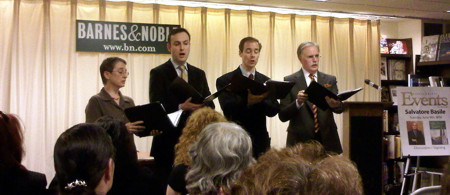
Performing at Barnes & Noble in New York. |
You are originally from Syracuse, NY. How did you come to be part of the Cathedral choir?A convoluted story. I came to New York to pursue a singing career, and did some moonlighting in church choirs. In early 1998, St. Patrick's was planning a concert. Because the Cathedral's music director had died the previous year, the bass soloist, John Calvin West, was directing the music. As he'd be conducting rather than singing, he realized that he needed a guest soloist; someone recommended me; I had the shortest audition of my life (six bars of music, I recall); and that was that. Soon after the concert, he asked me to join the choir as a full-time member. I've been there ever since. What drew you to writing about the musical history of St. Patrick's Cathedral? How did you go about doing research for FIFTH AVENUE FAMOUS?In 2004, St. Patrick's was celebrating its 125th anniversary and planning a concert that
would feature the works of previous Cathedral music directors. I was asked to write some
program notes for the concert — and that research was so interesting that it seemed only logical
to do a full-length history of the Cathedral's music. What is the most surprising thing you learned about the Cathedral's musical history?From the moment I first started researching the project, the thing that kept hitting me in
the head was the way in which the Cathedral’s musical history reflected so much of the city’s own
history. It became obvious that it wouldn’t do merely to give a dry list of facts and people; that
approach wouldn’t serve a story in which the ongoing lives of St. Patrick’s and New York City
were continually intertwining and influencing each other — a situation that probably hasn’t
happened to this extent in any other church in America. Was there one specific "golden era" of music at St. Patrick’s, in your estimation?I'd say there were two golden eras. The first one began with the Cathedral's opening in
1879. In those years, New York church music was big stuff, with orchestras, crackerjack choirs,
and soloists known as “stars.” People flocked to hear that music, the press reported on it in detail,
and everyone agreed that music at St. Patrick's was not only beautiful, but exciting. That lasted
until 1903, when Pope Pius X decided that liturgical music should be more “appropriate” to
worship . . . and that women shouldn't be involved in it at all. That was a major upheaval, and the
interest in the music dwindled. It is safe to say that the Cathedral is a quintessentially New York landmark and cultural institution, in addition to being a house of worship. At what point would you say it took on that role?At what point? Before it was completely built. St. Patrick's had begun construction in the 1850s, when New York wasn't taken quite seriously as a major city, and the location at Fifth Avenue and 50th Street was far out in the suburbs. By 1879, New York was a world capital, the city had expanded to take in the location — and boom, one of the largest cathedrals in the world was opening in midtown. New Yorkers immediately fell in love with the place. And from the opening day, any cultural event taking place in St. Patrick's would have an instant stamp of approval from many. (And an instant thumbs-down from others. People are like that.) Is there an overall theme or message about music in FIFTH AVENUE FAMOUS?There are a few messages. Oddly enough, they have nothing to do with music. I've found:
What is your favorite memory from your experience as a choir member at St. Patrick’s?I'd like to think there are occasions at which the Cathedral musicians were making a genuine contribution. Not all memories are joyous: Five years after 9/11, St. Patrick's hosted a memorial for members of the New York Fire Department. We sang the funeral chant In paradisum (“May the angels lead you into paradise . . . ”). As it is, the music is emotionally charged, and this time it was punctuated by Fire Department members ringing their Ceremonial Bell in memory of their fallen comrades. The choir was positioned at the altar; I happened to be standing right next to that bell. It was an honor to sing that day. It was also very, very hard to sing without completely breaking down. On the other hand, the choir sang last August for the wedding of our music director, Jennifer Pascual. That was a happy day; probably the most music-filled wedding ceremony in decades, with half a dozen organists, something like twenty priests, extra choristers . . . and plenty of celebratory chocolate in the music office. (Dr. Pascual knows her musicians well, she does.) |
|||||||||||||||||||||||||||
Designed by the Web Maven |
||||||||||||||||||||||||||||